
.svg)
.svg)
.svg)


Case Studies
The $88 Billion Blind Spot: Why Asia's Insurers Can't See Most of Their Fraud
Sep 16, 2026
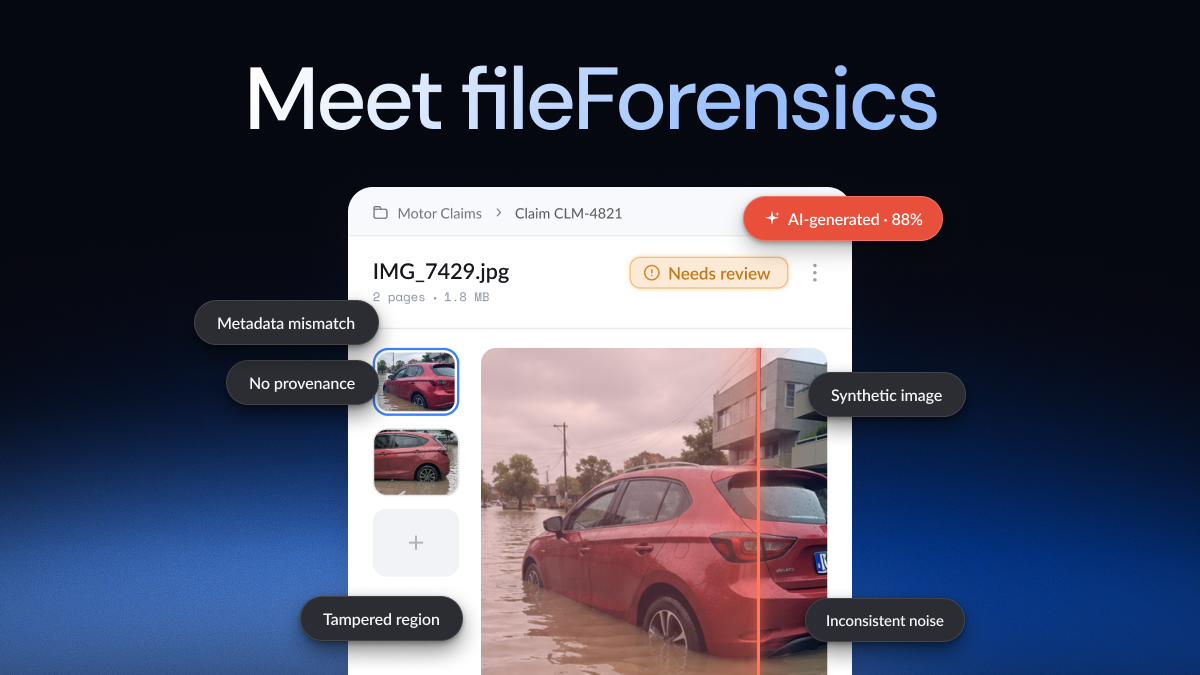
Quick answer: Document fraud in Asia's insurance industry is accelerating faster than manual and siloed fraud checks can keep pace with. Regulators in Singapore, Hong Kong, India, South Korea, China, and Indonesia have each launched fraud-specific mandates within a single 12-month window, several requiring real-time, cross-institution document checks. fileAI's latest innovation—fileForensics—addresses this by verifying document integrity, provenance, and manipulation at the point of ingestion, not whilst a claim assessment workflow is underway.

South Korea's insurers paid out a record 1.16 trillion won in confirmed fraudulent claims in 2025. That number alone is troubling. What's more revealing is what Korea's own Financial Services Commission believes it's missing: the regulator estimates true fraud exposure, detected and undetected combined, at roughly 9 trillion won—nearly eight times the confirmed figure (Korea Times, 2026). If the vast majority of fraud is invisible even to a well-resourced national regulator, the assumption that existing claims verification is "good enough" doesn't hold up.
This is not a Korea-specific story. It's a regional one, and it's happening right now. Across Asia-Pacific, organized-fraud losses hit an estimated US$88.3–114.1 billion in 2025, up from US$18–37 billion just two years earlier, more than a fivefold increase at the low end (UNODC, via Insurance Business). The region's cyber and fraud insurance premium capacity covers less than two cents for every dollar of documented loss.
This piece looks at what's driving that gap and why the structure of most insurers' fraud checks—bolted on, after the fact, siloed by department—is itself part of the problem.
How is document fraud impacting general insurers?
For insurers, the data is stark. Verisk's 2026 State of Insurance Fraud Study found that 99% of insurers have already encountered manipulated claims documentation, and 98% say AI-editing tools are fueling the increase (Verisk, 2026). Yet only 32% of insurers feel confident identifying deepfakes. That confidence gap is the real story: insurers know fraud is getting more sophisticated, but most don't yet have the tooling to prove it.
Singapore offers a concrete, human-scale illustration. In one recent case, an individual took genuine medical invoices, used an office computer to create 48 forged versions, and submitted them to an insurer to fraudulently claim more than S$12,000. The scheme ran undetected from 2023 to 2025 — three years — before manual verification with the medical institutions finally caught the inconsistencies (Singapore Police Force, 2026). That's not a story about a clever fraudster outsmarting AI. It's a story about a gap that manual, claim-by-claim review simply wasn't built to close quickly.
Why is AI making document fraud harder to catch?
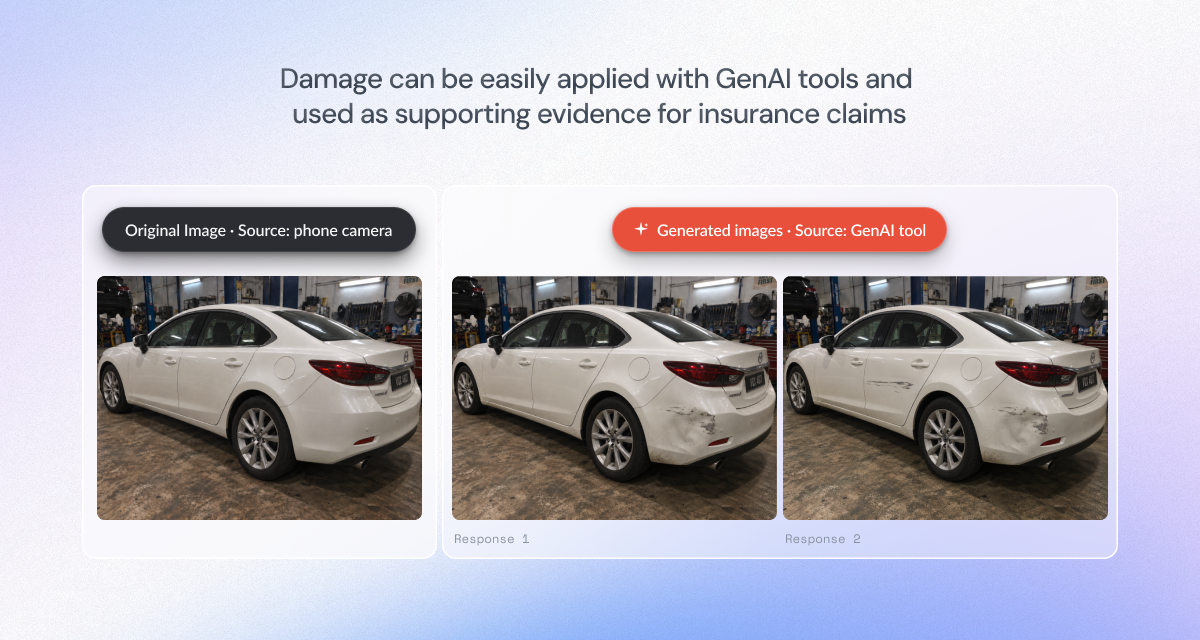
Generative AI has lowered the cost and skill required to fabricate convincing evidence. Fraud rings can now generate up to 20,000 fake IDs in a single batch, sold online for as little as $5 each (Gen Re, 2026). In motor claims specifically, Etiqa's CTO Dennis Liu notes that "documents can be manipulated to the point where they are virtually indistinguishable from authentic ones," with techniques altering dates, logos, and signatures "without leaving obvious signs of tampering" ((Re)in Asia, 2025).
KPMG's Chad Olsen adds a detail that matters for how detection needs to work: a single forged passport image was resubmitted more than 2,500 times with tiny variations in names, addresses, or hairstyles specifically to evade pattern-matching filters. Fraud at this scale isn't a single bad document—it's a pattern spread across many submissions, which is exactly the kind of signal that disappears when documents are reviewed one at a time, in isolation, by different reviewers.
Why do disconnected fraud checks hurt insurers?
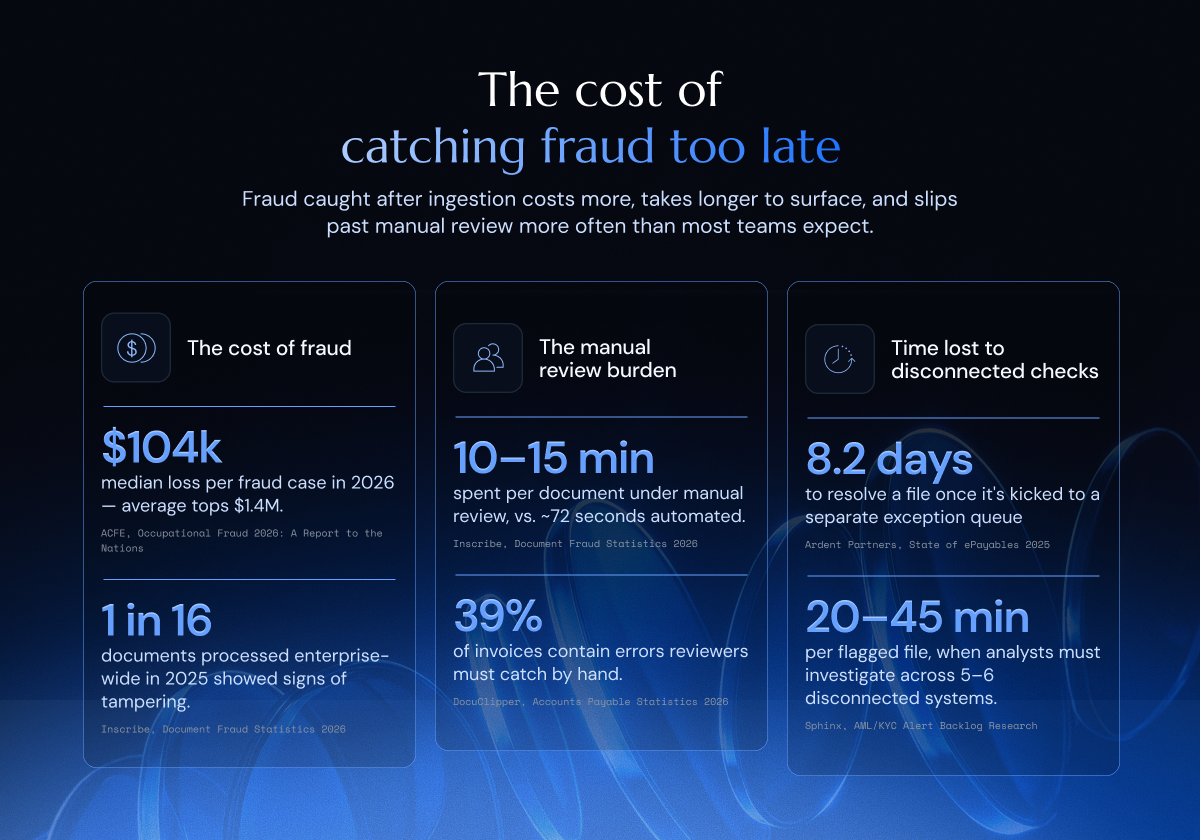
Most insurers already own the pieces—OCR, claims systems, SIU teams, fraud analytics—but those pieces rarely talk to each other. Genasys Tech estimates the global insurance industry spends roughly $210 billion a year on IT, and only 13% of that goes toward genuine transformation; the rest keeps fragmented legacy systems running (Genasys Tech, 2026). Insurers running duplicate, disconnected systems carry operating costs 3–4x higher than peers on consolidated platforms.
The claims-side impact is just as direct. Claims leakage runs 7–14% of total payouts industry-wide, and root causes point squarely at fragmentation: "manual processing of PDFs and documents without system cross-checking," and legacy systems that don't integrate claims, policy, and payment data (Insurance Thought Leadership, 2026). Inaza puts it plainly: fraud detection needs to move from a retrospective, bolted-on check into something embedded directly at intake, because "inaccurate or incomplete FNOL submissions can obscure fraud signals and delay detection mechanisms" (Inaza, 2026). The longer fraud takes to surface, the more of the loss has already crystallized—payment issued, reserves set.
How does fileForensics close this gap?
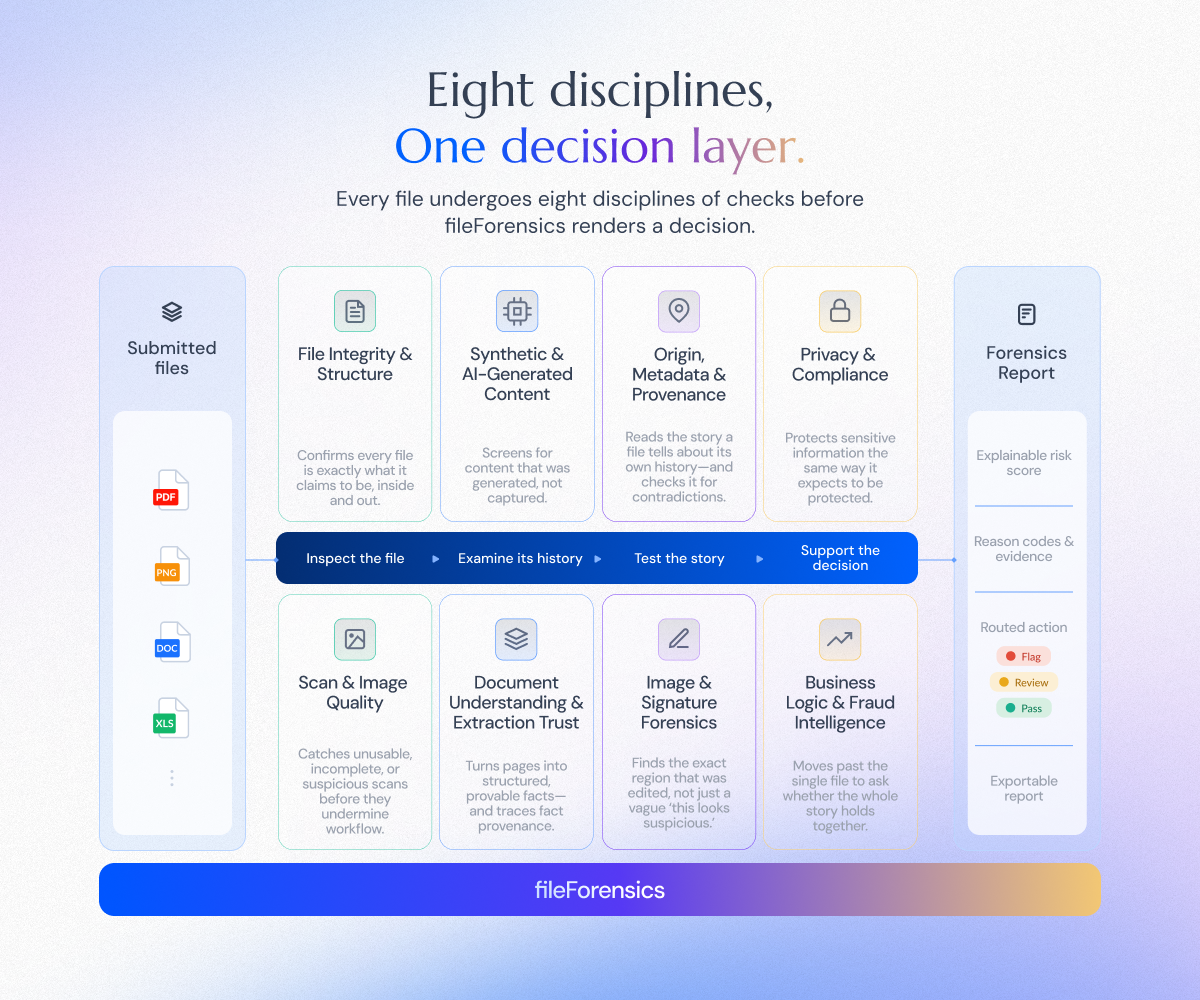
FileForensics is built on a simple premise: fraud detection belongs at the moment a document enters the workflow, not days or weeks later. Every file submitted—a photo, a scan, an invoice, a signed form—passes through eight capability domains before it reaches a decision layer.
- File integrity and structure: confirms a file is exactly what it claims to be, catching disguised formats and hidden or tampered content.
- Scan and image quality: flags unusable, incomplete, or suspiciously altered scans before they move downstream.
- Origin, metadata, and provenance: checks a file's stated history for contradictions, like a "created" date that falls after a "modified" date.
- Image and signature forensics: pinpoints the exact region of an edit — a cloned area, a spliced date, an altered amount — rather than a vague suspicion.
- Synthetic and AI-generated content: screens for images, text, and signatures that were generated rather than captured.
- Document understanding and extraction: turns pages into structured facts that are provably grounded in the document itself.
- Privacy and compliance: catches redactions that don't actually work and flags sensitive data without exposing it.
- Business logic and fraud intelligence: connects entities and behavior across submissions to reveal coordinated activity — the pattern-based fraud that single-document review misses entirely.
This is precisely the gap Gen Re points to: identical or near-identical documentation appearing across unrelated claims is only visible when documents are checked systematically at the point of entry, not sampled after the fact. FileForensics turns that principle into an operational layer, producing a single risk rating and a timestamped, exportable evidence report for every file it processes.
What should insurers do next?
The regulatory backdrop has already shifted. Six major Asian markets have moved on fraud-specific mandates within a single year, and several are explicitly requiring the kind of real-time, cross-checked document verification that siloed, after-the-claim review was never designed to deliver. Insurers that keep fraud detection as a downstream, disconnected step will keep finding out about fraud years too late—as Singapore's three-year forged-invoice case shows all too clearly. The insurers moving fastest are the ones building verification into the document ingestion process itself, at the first point a file enters the system.
Keen to learn more? Get in touch with one of our team today.
The $88 Billion Blind Spot: Why Asia's Insurers Can't See Most of Their Fraud

.png)
Business Type

Location
fileAI feature highlights
Case Studies
Author
fileAI
Date
September 16, 2026
.png)