


Executive summary
Toshiba, a leading multinational electronics manufacturer, uses fileAI to address inefficiencies in processing procurement files. Previously, manual handling averaged 92 minutes per file. By embedding fileAI APIs, Toshiba automated the workflow for multilingual (English, Mandarin, Thai, etc), printed, and handwritten invoices, packing lists, and bills of lading. As a result, file processing time was reduced by 82% to just 17 minutes. This substantial improvement allowed Toshiba to significantly cut operational costs, reallocate personnel to high-priority tasks, and scale document processing capacity by 20x.
Customer profile
Industry: Electronics Manufacturing
Revenue: US$24.8B (2023)
Employees: 95,109
File Types: Invoices, packing lists, bills of lading
Languages: multilingual
Business challenge
Toshiba faced significant inefficiencies with manual processing of procurement files. Each file required extensive manual entry, validation, and processing, leading to slow turnaround times, high labor costs, and limitations in operational scalability.
Objectives
Reduce the average file processing time significantly.
Improve accuracy and reliability in file handling.
Scale processing capacity to meet increased operational demands.
Reallocate manpower to higher-value business activities.
Solution architecture
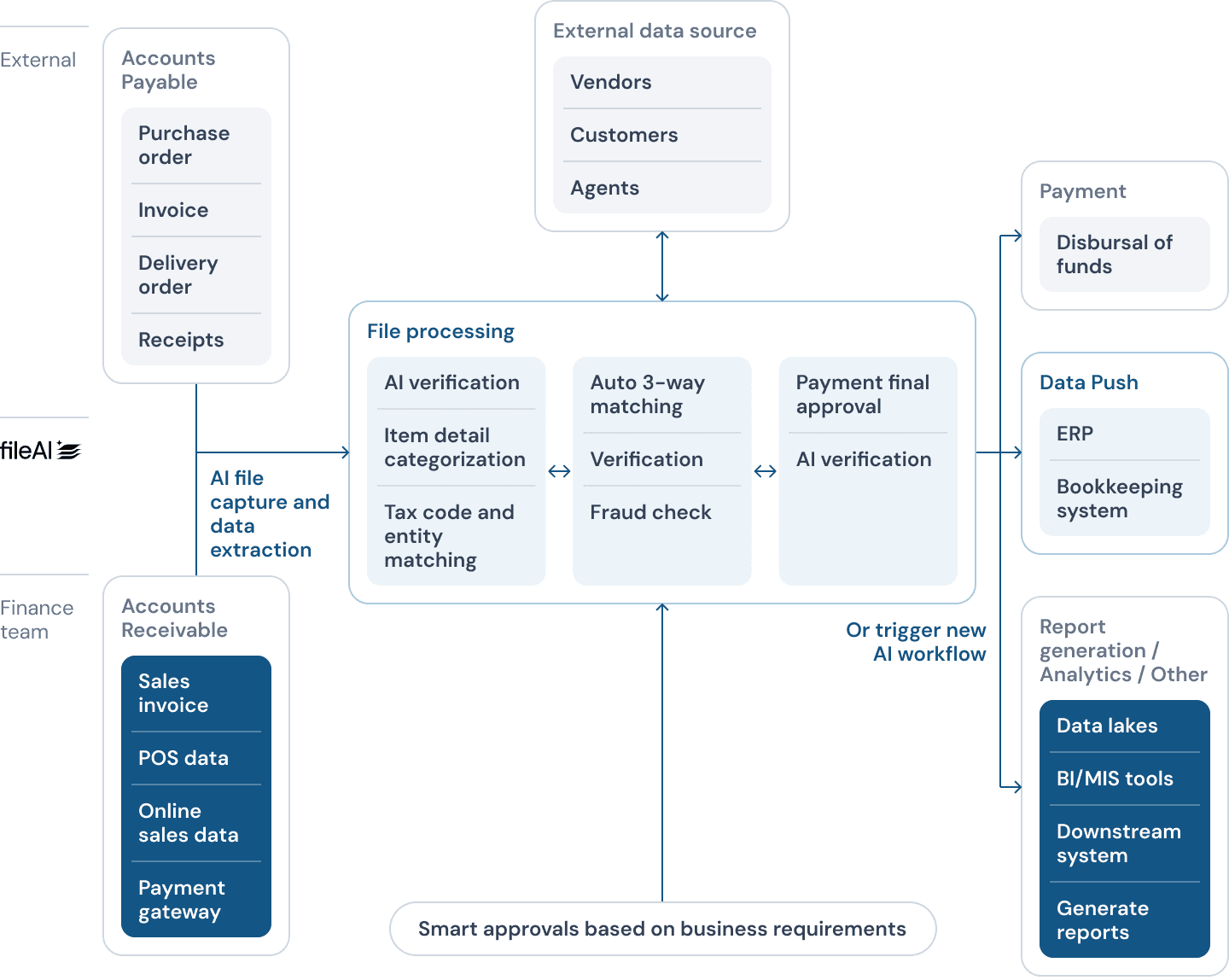
API endpoints and middleware components
fileAI API endpoint includes: | Role |
|---|---|
fileAI AI OCR Extraction | Extract multilingual information from documents |
Classification | Zero-shot classification without upfront training |
Validation | Validation of data with AI |
Secure REST API Gateway | Ensure secure transmission and compliance |
Implementation stats
Phases: Testing, Implementation, Go-live
Duration: 6 weeks
Key activities:
Integration of fileAI API
Testing and validation
Training and change management
Key features leveraged
fileAI AI OCR
fileAI AI Classification
fileAI AI Validation
Secure REST API infrastructure
Results
Metric | Before (manual) | After (fileAI) | Improvement |
|---|---|---|---|
File processing time | >92 minutes | 17 minutes | 82% reduction |
File handling capacity | Baseline | 20x increase | 1,900% volume expansion |
Operational cost savings | Baseline | Significant | >60% OPEX |
Manpower reallocation | None | Extensive | Higher-priority tasks |

Auntra Matchima
Import Officer, Toshiba
Key takeaways
Early engagement with stakeholders was crucial to simplify integration efforts and accelerate adoption across Toshiba’s operations. Comprehensive testing, particularly focused on multilingual and handwritten file processing, substantially reduced potential issues post-implementation. Additionally, ongoing monitoring and analysis have been key to sustaining continuous improvement and effectively adapting to evolving business requirements.
Next steps with fileAI
Looking ahead, Toshiba plans to broaden the adoption of fileAI technology to handle additional document types and business processes. Continuous optimization of the existing APIs is also underway to achieve even greater efficiency and accuracy. Moreover, Toshiba will explore deeper integration capabilities, aiming to leverage AI-driven analytics to unlock further insights and enhance procurement decision-making.
